
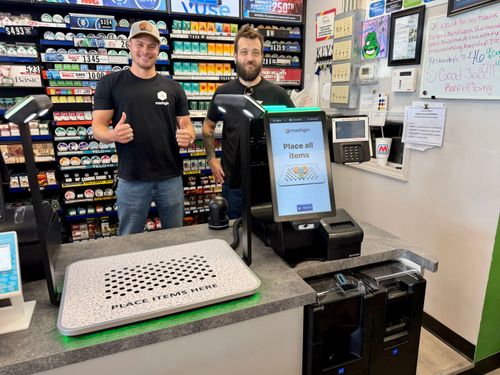
Is Mashgin worth the extra cost compared to traditional self-checkout machines like NCR?#
For high-volume stores, yes. Traditional self-checkout makes shoppers scan every item themselves and often can't handle age-restricted items, hot food, or lottery without staff. Mashgin rings up everything on the tray at once, supports nearly every transaction type, and keeps a cashier in the loop. It costs more per unit, but operators typically recover the cost within months through higher sales and labor efficiency (see Mashgin pricing and ROI).
| Traditional barcode self-checkout | Mashgin AI checkout | |
|---|---|---|
| How items are identified | Shopper scans each barcode | Cameras identify every item on the tray at once |
| Items without barcodes (hot food, produce, fountain drinks) | Manual lookup or code entry | Recognized visually |
| Alcohol and tobacco | Usually restricted or requires staff approval | Supported. The kiosk pauses for an attendant ID check |
| Who does the work | The shopper | The AI, with a cashier nearby to assist |
| Checkout time | Depends on cart size and scanning skill | 11–18 seconds in Mashgin case studies |
What is the best self-checkout technology?#
Most traditional self-checkout systems work the same way: a barcode scanner plus manual lookup for everything else. Choosing among them mostly comes down to price and how well they integrate with your existing systems.
AI-based checkout is the biggest change in the category. Mashgin invented and patented multi-camera 3D computer vision for item recognition. It runs in 5,000+ locations, including convenience stores, 65% of professional sports stadiums, hospitals, universities, and airports.
Why hasn't self-checkout technology improved?#
Grocery self-checkout has changed little in years because it's still built around scanning barcodes one at a time. The real change is happening in convenience stores, stadiums, cafeterias, and micro markets, where computer vision checkout lets shoppers place all their items on a tray, pay, and go. Mashgin invented this approach and has the largest installed base. Its monthly transaction count grew from 3 million in March 2022 to 40 million in March 2025, and it processed more than 440 million transactions in 2024.
Do customers actually use self-checkout?#
Many do, but opinions are split. Some shoppers like the independence. Others see traditional self-checkout as shifting the cashier's work onto them, and it can be clumsy for non-barcoded items.
AI checkout removes the scanning step, which changes shopper sentiment. In Mashgin's 2026 survey of 2,500 U.S. convenience store shoppers, 80% preferred Mashgin over traditional checkout. Mashgin also supports almost every in-store transaction type: cash, alcohol, nicotine, EBT, fuel, and hot food.